Our History

Martin Luther and the Reformation
Along with all other Lutheran churches, the LCA traces its roots directly to a 16th century movement for renewal of the church known as the Reformation.
Martin Luther was an Augustinian monk assigned to lecture in biblical theology at the University of Wittenberg in Germany. Even though he lived the life of a conscientious monk, Luther felt that he was not able to please God, but as he studied the Bible he began to realise that its central message is about God’s overwhelming love for us in Christ.
The Bible teaches that we are saved by God’s grace, through faith in Jesus Christ, and not by our own efforts to please God. And so Luther began protesting against church practices of that time which gave people the impression they must contribute to their salvation. Good works do not earn us salvation, Luther taught, rather, faith active in love is fruitful in a good life and good works.
Luther’s teaching, sermons, and writings inspired others to join him in working for reform of the church. Beginning at Wittenberg, evangelical reform spread to many areas of Northern Europe, especially in Germany and the Nordic countries. In 1530 Lutheran leaders were summoned to give an account of their faith before the parliament of the empire gathered at Augsburg.
The confession of Christian faith they presented to the emperor is known as the Augsburg Confession, and this has become the charter of Lutheran churches all around the world. As the movement for reform spread, other leaders came to the fore, and sadly divisions appeared among them. Those who followed Luther were nicknamed 'Lutherans'. Luther himself would have preferred them simply to be called 'Christians', but eventually the name was adopted.


The spread of the Lutheran Church
After the Reformation, the Lutheran church went through times of internal dissension and was beset by external perils of various kinds, culminating in the horror of the Thirty Years War. In these years Lutheranism had to define and defend itself, and this is called the period of orthodoxy. Eventually, it was agreed that people should basically follow their leaders: if the duke is Catholic, his people should be too; if the prince is Lutheran, his people should follow him. Following this pattern, various regional churches developed in Germany, whereas in the Nordic sphere entire nations followed their rulers in becoming Lutheran.
When northern Europeans began to be involved in colonial expansion, those from a Lutheran background took their faith with them and over a period of time established new Lutheran churches. German and Nordic Lutherans settled in the new world of the Americas, and later in countries such as South Africa, Australia and New Zealand. A movement for renewal in the life of the church called pietism was the impetus for mission both at home and abroad. Lutheran missionaries took their evangelical faith to many parts of the world such as India, Asia, Africa, Madagascar, Indonesia and Papua New Guinea. Over a period of time, these missions grew up to become young independent Lutheran churches with indigenous leaders.
The faith communities that grew out of the Lutheran movement are often called evangelical Lutheran churches. The word 'evangelical' shows that they are committed to preaching, teaching and living out the gospel of Christ.
Our beginnings in Australia and New Zealand
The Lutheran Church was established in South Australia in 1838 by German emigrants from Prussia who came because of religious persecution. Although this persecution ceased in the mid-1840s, many more Germans followed, seeking the better life that the first migrants reported to them. Settlements were established at Klemzig, Hahndorf, Lobethal and in the Barossa Valley. Some 20,000 German Lutherans migrated to South Australia between 1838 and 1860. With the expansion of settlement, the German Lutherans began to spread out across the state in search of larger landholdings. In their settlements, they soon built churches and schools.
German Lutherans also came to Victoria from the 1840s onwards and established the Lutheran Church in the Melbourne district. Some Germans moved from South Australia to Victoria, first to the Hamilton district in the 1850s and then to the Wimmera in the 1860s and 1870s. In the 1860s, Lutheran families moved from South Australia to the southern region of New South Wales as land became available for selection. As a result, the Riverina became the main area for the Lutheran Church in New South Wales.
German migration to Queensland began in large numbers in the 1860s. Their places of origin in Germany were different from those that produced the earlier migrants to southern Australia. Because of the distance from South Australia, separate Lutheran Churches were established in Victoria and Queensland. Only a small number of Lutheran congregations were established in Tasmania and Western Australia. As a result, 45 per cent of all Lutherans in Australia today are found in South Australia. Queensland has 25 per cent, Victoria 15 per cent, and the remaining 15 per cent in New South Wales, Western Australia and Tasmania.
Despite three Australian-trained pastors graduating in 1855, most of the pastors in the 1800s came from Germany, especially from the theological seminaries of Hermannsburg, Neuendettelsau, and Basel in Switzerland. From the 1880s, the church sought pastors from the US (Missouri Synod, or Iowa Synod). From the early 1900s, they began training pastors in Australia at Concordia College and Immanuel College in Adelaide.


Responding to change
German continued to be the language of many Lutheran homes for up to three or four generations. Similarly, the language of the Lutheran Church was German in its worship and its business. In the early 1900s, moves were made to introduce English, and this was hastened by the outbreak of World War I. There was a transition period in the 1920s and 1930s, and after World War II, only English was used.
The provision of education for their children was a priority for the early Lutherans. Many congregational primary schools were started in the 1800s. During World War I, the schools in South Australia were closed by an Act of Parliament. However, they gradually reopened after the war. Secondary colleges were also started in the 1890s. In the 1970s and 1980s, there was a rapid expansion in the Lutheran school system, and numerous primary and secondary schools were established, especially in Queensland.
Mission with Indigenous people
The Lutheran Church has been very much involved in mission work to Aboriginal people. Early efforts at Adelaide and Brisbane were short-lived. In the 1860s, a mission was started on the Cooper's Creek in South Australia, but it survived for only 50 years. In the 1870s, the Finke River Mission was started at Hermannsburg in Central Australia, and it still continues. In the 1880s, the Hope Vale Mission was started in northern Queensland and also the New Guinea Mission. In South Australia, the Koonibba Mission was started in 1901 and the Yalata Mission in 1956. The preaching of the gospel continues in these areas today. One special feature of Lutheran missions has been the use of the local Indigenous languages.


Division and unity
The early Lutheran Church in Australia has unfortunately been marked by division. The first pastors, August Kavel and G D Fritzsche, disagreed on a number of matters and in 1846, they established separate churches. Further division led to more separate churches forming. Victoria established its own church, and Queensland had two Lutheran churches. As a result, in the early 1900s, there were eight separate Lutheran churches, plus some independent Lutheran pastors.
In the 20th century, efforts were made to bring unity, and in 1921, five churches joined together. Another one joined in 1926. The final union in 1966 created the present-day Lutheran Church of Australia.
A historic agreement
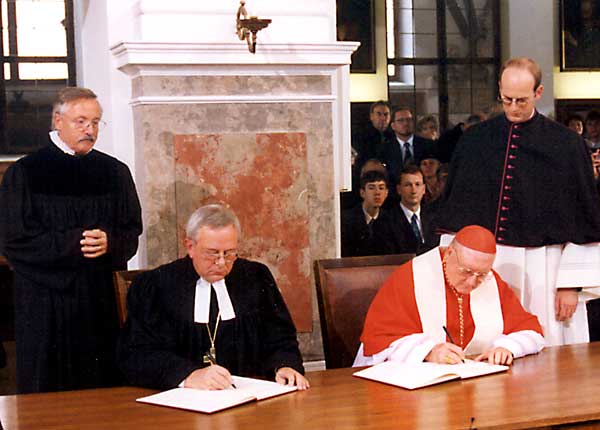
In October 1999, after years of committed dialogue, the Catholic Church's Pontifical Council for Promoting Christian Unity and the Lutheran World Federation signed a historic agreement, the Joint Declaration on the Doctrine of Justification (JDDJ). The agreement states that the churches now share 'a common understanding of our justification by God's grace through faith in Christ'.
Since the difference of opinion about justification was at the heart of the Reformation and the forming of breakaway Protestant churches, the joint declaration was a pivotal step towards bridging a 500-year-old division.

Resources
Lutheran Archives has compiled Lutherans in Australia: a Bibliography for those wishing to read more about our history.
How did we do?
Did you find what you were looking for? Did you find anything out of date or not working properly? Please tell us how we can improve this page.
