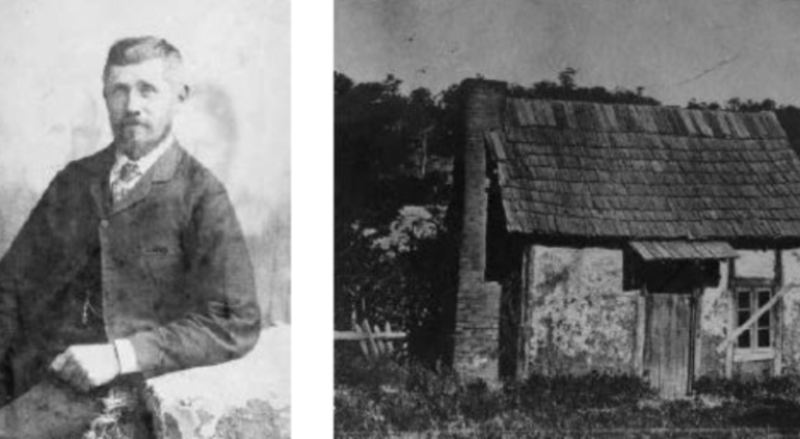
Dear Teacher

In 1847 Johann Ferdinand Mueller underwent a public examination in front of the Lobethal congregation, at the end of which he was awarded a certificate in teaching. With this, Ferdinand Mueller became the first Lutheran teacher to be trained in Australia.
In September 1842 Ferdinand began teaching at Lobethal, shortly after its settlement. His teaching abilities had been recognised the previous year on his voyage to Australia, when he was prevailed upon to teach the children aboard the Skjold. Upon arrival in the colony, he first worked as a shepherd in the Onkaparinga area, noticed the land we now know as Lobethal, and was instrumental in the settlement of the Lutheran village there. He wrote detailed reminiscences that form the basis of much of our knowledge of early Lutherans.
Because I could always recite my lessons well I received a new Bible as a gift from the Pastor. This Bible was now by far my most prized possession
But what was the path that led him to become a teacher?
Johann Ferdinand was born in October 1813 and grew up in the village of Bilsko, near the town of Birnbaum (now Miedzychod) in Posen. He attended the Bilsko village school from the age of five. Naturally his family had to pay for him to attend school and to learn to read—the fee was doubled if the child was also taught to write.
Technically, the school house consisted of four rooms. Practically however, one room was occupied by the village blacksmith and another by the cowherd, who also doubled as the night watchman. The teacher’s wife used one of the rooms for cooking and washing, and at the same time teaching the children whenever her husband was absent. The teacher, by name of Paech, was also a shoemaker and ‘during the school time had to occupy himself with mending shoes and making new ones to earn some extra money if he was to exist on his trifling salary’. In his autobiography, Ferdinand says, ‘We children had to stand at his workplace and recite our lessons; sometimes however, he pulled the thread out so far that the student standing nearest received a solid thump on the head, this happened especially if he could not recite his lesson fluently’.
From a young age Ferdinand was keen to learn. One day, to his delight, his father arranged for him to also learn writing and arithmetic, and he received a wooden black-board and a piece of chalk from the teacher. No longer was he a ‘reading only’ student! Friedrich went to school with great pleasure. Arithmetic became his favourite subject. He advanced so far in reading, writing, hymn-singing and reciting catechism, gospels and epistles that he was placed second in the school. He attempted to become the top pupil, arranging to receive tutoring from a neighbour who was attending the school in Birnbaum, but was unsuccessful in this endeavour—primarily because the mother of the top student plied the teacher with sausages, butter, cheese and other delicacies.
This dampened Ferdinand’s zeal for learning so much that his father removed him from the school and enrolled him in the local Catholic school. Here Ferdinand attended daily mass and soon became an altar boy, tolling the bell each time the priest said ‘Amen’. Yet Ferdinand again became disheartened, writing that ‘nothing was taught beyond the copying of the Sunday and festival day pericopes and pamphlets: there was no thought of arithmetic or history. All this aroused in me the longing desire to go to a better school.’ When Ferdinand was eleven, his father enrolled him in the Birnbaum Evangelical congregation school, a three-quarter hour walk away. Here he thrived. He became a choir student; hymn-singing on Sundays and at baptisms, marriages or burials gave him the greatest pleasure, which extended to his days teaching in Lobethal.
At thirteen he began confirmation instruction. ‘Because I could always recite my lessons well, I received a new Bible as a gift from the Pastor. This Bible was now by far my most prized possession. After this there grew in me a wish to become a teacher.’
Private tuition from the pastor and the cantor was arranged in order to fulfil this aim. Sadly however, his mother’s death and his own illness prevented him from studying for two years. He was at last confirmed and worked for a time as a coachman, whereby he came into contact with Pastor Fritzsche and other Old Lutherans, contact which eventually led to his emigration to Australia.
In 1842 Pastor Fritzsche began the first Lutheran training institute for pastors, missionaries and school teachers, based in Lobethal. Ferdinand applied first to train as a missionary but was encouraged otherwise. He began teaching at Lobethal in September, with a salary of nine pounds—so meagre that Pastor Kavel personally gave him three acres of wheat as a supplement. Meanwhile he undertook training, usually given on the road while Pastor Fritzsche travelled between congregations. In 1883 Ferdinand retired from teaching after 42 years, at 70 years of age.
Anna Ey, a student of Ferdinand’s, writes in her memoirs ‘I will never forget my last day at school. We girls decided that we would go and say “good-bye” to our dear teacher, thank him for all he had done for us, and ask him to forgive us where we had annoyed him. The good man was quite taken aback when I began. He wished us God’s blessing and guidance through life, whilst the tears ran down his cheeks.’
Rachel Kuchel is LCA Archivist.
