United – despite our differences

Celebrating 50 years of the Lutheran Church of Australia offers a wonderful opportunity to step back, reflect and thank God for his blessings.
This month sees the 50th anniversary of that historic Union Day. Some say we shouldn’t live in the past, but how can we really know who we are if we do not know where we came from? How can we appreciate our God-given unity if we ignore the prior division? How can we be good stewards of the church we have inherited if we have no concept of the one that existed before?
How can we appreciate our God-given UNITY if we ignore the prior division?
Like many family trees, our church’s is a bit messy. There were unions but also divorces. The most significant split was at the 1846 Bethany Synod, SA, when disagreement over church governance and confessionalism saw the convention break up. What followed was 120 years of division!
Over time there were more splits, and with further migration, new synods. By 1907 there were seven synods in Australia, two in New Zealand, and numerous independent ministers and congregations.
Apart from their diverse origins, it was the sourcing of pastors from Protestant – not confessionally Lutheran – seminaries that caused issues for the confessional synods. Their sensitivity to the threat of Lutheran/Reformed ‘unionism’ is understandable – after all, the rejection of such a stance was the reason the first Lutheran migrants came to Australia. How could such disparate groups ever unite?
Commitment to Aboriginal mission brought the original South Australian synods together in a ‘confessional union’ in 1864, but this ended in further splits, again largely over affiliations.
However, a crucial milestone was reached in 1921. Having agreed on doctrine, five of the synods came together as the United Evangelical Lutheran Church in Australia (UELCA). In 1926 another synod joined them.
There were now two synods of similar size, with different cultures and backgrounds. The other was the Evangelical Lutheran Synod of Australia (ELSA, later ELCA), which had been sourcing pastors or training in America, and had widely introduced the English language. Until the disruptions of war, UELCA had largely used German seminaries to train pastors and its links with Europe and the German language remained stronger.
In the 1920s and 30s the differences between the synods were highlighted in bitter articles and pamphlets. Worship, communion or marriage with those of ‘the other side’ were frowned upon; even joint prayer was considered ‘sinful unionism’.
But there were shared schools, and joint cemeteries, church buildings, youth groups and mission work. The Australian Lutheran Association provided fellowship across synod lines, and later played an integral role in uniting the church.
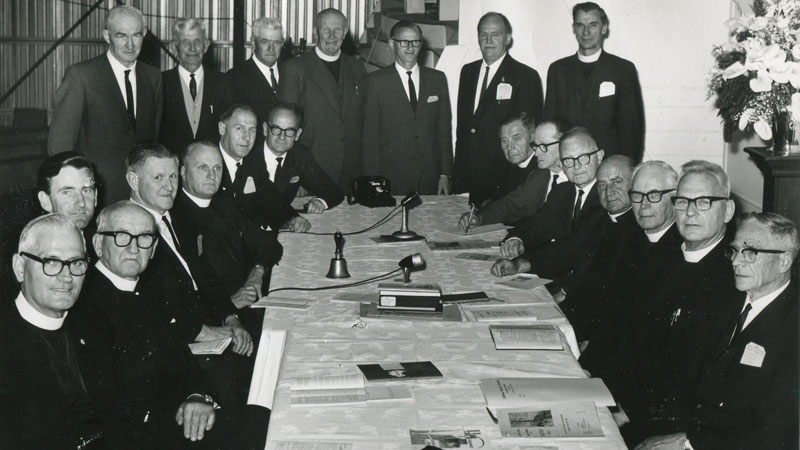
In the 1940s the focus shifted to points of agreement between synods and their minimum requirements for union. What constituted God-pleasing unity? A joint intersynodical committee formulated theses of agreement. There was much rejoicing when in 1949 the joint meeting opened with prayer for the first time, and in 1952 when they reached agreement on most differences.
Union seemed imminent and some ELCA and UELCA congregations in Queensland and South Australia built combined churches. But in 1956 an ELCA convention rejected an offer of altar and pulpit fellowship from UELCA. Despite a desire for unity, relationships with overseas church bodies – Lutheran World Federation, the churches involved in New Guinea missions – impeded fellowship. Hopes for union were fading.
Then came a breakthrough! Concordia and Immanuel seminaries drafted ‘a common theology of cooperation and fellowship’ which became the basis for the Document of Union in 1965. This was endorsed at the ELCA synod in April and the UELCA in October.
On 28 November 1965 thousands of Lutherans gathered at Adelaide Oval, Melbourne Town Hall, Brisbane, and centres throughout Australia to celebrate the Declaration of Altar and Pulpit Fellowship. Combined services and functions were held but there were practicalities to be addressed. What would the new church be called? How would it be structured? The Joint Union Committee planned the organisational and legal steps for amalgamation, including a constitution, the transfer of properties, and the merger of departments, magazines and seminaries.
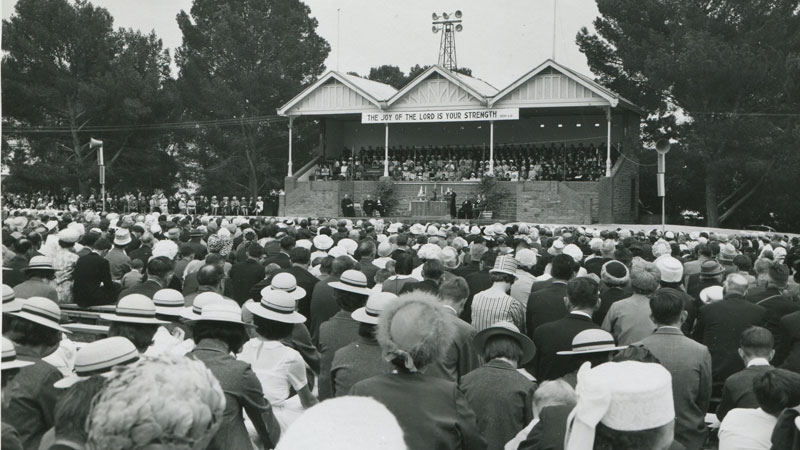
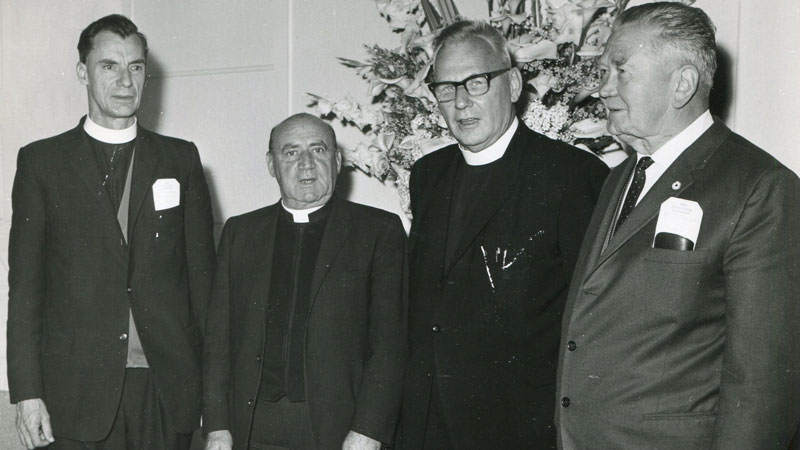
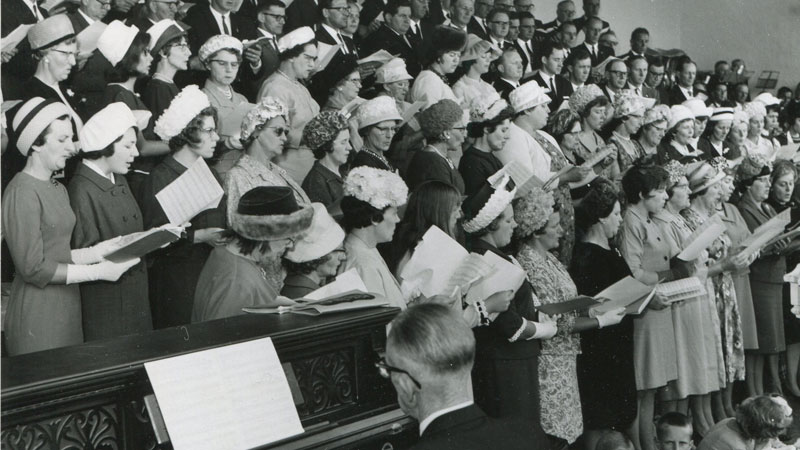
Sunshine echoed the mood of Lutherans who packed Tanunda Show Hall in the Barossa Valley on 29 October 1966 to witness the LCA’s birth. The two synod presidents, Max Lohe and Harold Koehne, shook hands to end 120 years of division. Lohe was elected the first president of the LCA, Koehne vice-president. Next morning the valley rang with hymns of praise from 10,000 thankful people.
In the years leading to Union, we can see God’s faithfulness. Despite our divisions and conflicts, failings and brokenness, he has blessed us and been a blessing through us. He has called us to unity in Christ. These years are a reminder that our unity is built on Christ’s completed work in his death and resurrection. And they highlight the importance of repentance and forgiveness, of listening to each other, and bearing with one another in love, despite our differences.
From the Document of Union
‘We accept this unity as an unmerited gift of our God, in sincere repentance for what lies behind us since our fathers went their divided ways, and in humble gratitude for all that God in His mercy has worked through each of us in the years since 1846 … We believe that the union between our church is His holy will for us at this time.’
New Zealand
There were many mission ventures in New Zealand from 1843 onwards. However, it was not until 1889 that the New Zealand Emanuel Synod was formed. It had a loose association with the Immanuel Synod. Its formal association with the UELCA Synod lasted until 1958. The Concordia Conference was established in 1907 and associated with the ELSA Synod until 1920, when it became a district of the ELSA Synod. At Union, New Zealand became a district of the LCA. It is now known as Lutheran Church of New Zealand.
Janette Lange is Acting Director and Archivist of Lutheran Archives.
This feature story comes from The Lutheran October 2016. Visit the website to find out more about The Lutheran or to subscribe.
READ MORE STORIES ABOUT 50.500, church union
