The beauty within

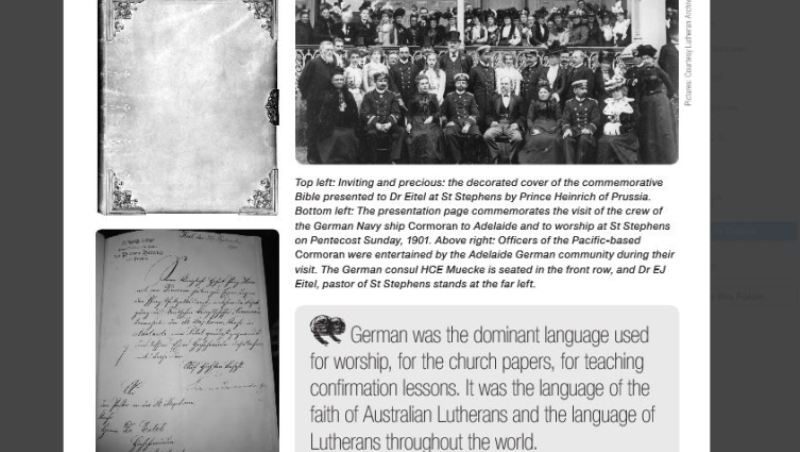
My mother always encouraged me not to judge a book by its cover. Difficult in my line of work! Imagine soft leather, gilt edges, embossing and filigree. Tempted and swayed, too often I’ve disregarded Mum’s advice and fallen for the cover and not what is inside.
But what if I open the book and am surprised by the contents? What if it contains a message of presentation to Dr Eitel—pastor of St Stephens congregation, Adelaide—from Prince Heinrich of Prussia, in ‘remembrance of the Pentecost service, which the garrison of the German battleship Cormoran attended’. Witnessed by
a detachment of cadets of the training ship, Herzogin Sophie Charlotte, the consul for the German Empire presented the Bible to the congregation on Christmas day, 1901.
In truth I think it’s exciting to hold a book given by a Prussian prince, but what if the year is 1915 when Australia is at war with Germany? And what if I’m looking at a Lutheran in Australia who speaks German? Should I follow my mother’s advice, or be swayed by the ‘cover’?
Outwardly, the Lutheran Church in Australia appeared thoroughly German at the outbreak of World War I. German was the dominant language used for worship, for the church papers, for teaching confirmation lessons. It was the language of the faith of Australian Lutherans and the language of Lutherans throughout the world. In America, towards the end of the 19th century, some resources were beginning to be translated or written in English, but this was barely a ripple.
Many pastors of the Immanuel and other synods (later UELCA) were ‘imported’ from Germany or were Australian Germans who went to seminary in Germany. The Evangelical Lutheran Synod of Australia (ELSA) had started to draw its pastors and theological resources from America, and it began publishing an English edition of its church paper in 1913, but by and large, Lutheran churches in Australia were still ‘German’ in matters of their faith.
Were these Lutherans German patriots on the ‘inside’? From the beginning, our forebears were truly thankful for the liberties afforded to them in their new country. After the first constituting synod in May 1839, 121 attendees walked to Government House in Adelaide to sign and pledge an oath to ‘bear true allegiance to Her Majesty Queen Victoria. So help me God.’ The date was Queen Victoria’s birthday.
‘We have found what we have been seeking for many years—religious liberty: we hailed, and hail that Sovereign under whose direction we are now placed: we consider her and her Government as ordained of God, and with all our heart we are desirous of being faithful subjects and useful citizens’, Pastor Kavel said.
Newspapers regularly reported on events of ‘our German friends’, noting their steadfastness, work ethic, cultural peculiarities and their faith. Church events, such as dedications, regularly included a German service in the morning and an English service in the afternoon—always well attended by the community at large. In 1899, the lieutenant-governor of South Australia, Sir Samuel Way, laid the foundation stone for St Stephens church. The scene was ‘gay with flags which fluttered from the scaffold poles … the German flag and the Union Jack were floating in the breeze side by side.’
St Stephens celebrated British and colonial events with as much fervour as German events. Within months in 1901 the congregation mourned equally the deaths of Queen Victoria and the dowager Empress Frederick, widow of German Kaiser Friedrich III.
In 1913, to the chagrin of other Lutheran congregations, St Stephens celebrated Kaiser Wilhelm II’s 25th jubilee. In Queensland, the German consul Dr Hirschfeld requested ELSA pastors ‘to preach a celebratory sermon to honour the Kaiser, who in his person incorporates the German Fatherland.’ The pastors refused, responding that ‘as British subjects their undivided loyalty was to the British crown and they saw no reason to join in the celebration of a foreign ruler’s jubilee, and that it was their calling to spread the gospel but not to propagate German culture’.
German language for their faith, customs and traditions was separate from loyalty for their adopted homeland.
But with war imminent, it was natural for Lutheran churches to be nervous. Presidents of all synods issued public statements of the Church’s faithful allegiance to the British monarchy. Congregations, too, pledged their support. In August 1914, ‘a large and representative meeting of German residents of Ni Ni Well, Lorquon, Woorak, Glenlee and Netherby [in Victoria], was held for the sole purpose of proclaiming unbounded loyalty to the British Throne’. The congregation of St Johns in Perth resolved ‘that they are all loyal subjects of King George V, and that they desired to assure you of the loyalty of the members of the congregation’.
Sadly, public tensions mounted, as often too many only contemplated the book’s cover. In November 1914 Harry Samuel Taylor, editor of the Murray Pioneer and Australian River Record urged his readers to consider the ‘inside’ of the ‘book’: ‘Because we believe that the unspeakable crime of the present war lies primarily at Germany’s door … there is a not unnatural disposition to look askance on many worthy men amongst us who happen to be of German blood. This is a tendency to be fought against … Through long years of trial our German fellow citizens have been tested and their worth proved. They are good Australians; the great bulk of the German-Australians belong to a different generation and a different faith than the present day inhabitants of Germany.’
Rachel Kuchel is LCA Archivist.
