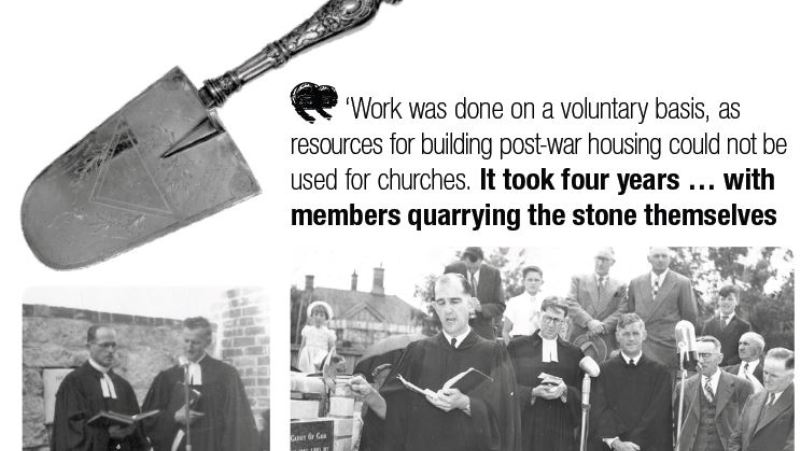
The travelling trowel

I call it the travelling trowel. Its working life begins in Perth in 1903. It is 29 April and the day of the foundation-stone laying for the new St Johannes school and church. Rev EH Fischer had been sent to the Western Australian mission field two years earlier as a church planter, staying until 1910. The silver trowel he used to lay the stone was particularly beautiful, engraved with the details of the auspicious occasion.
We next meet our trowel five decades later, residing at the ELCA archives at Concordia College in Highgate, South Australia. Hopefully, it has rested well, as it is about to get a good workout travelling between South Australian and Victorian ELCA congregations! It is loaned out to Rev Clarence E Zweck so that he can lay the foundation stone for the Colonel Light Gardens Trinity church, on 11 November 1951.
Ministry in the Colonel Light Gardens area had begun in the 1930s, with Rev G Blaess establishing a Sunday school. Initially, Sunday school was held in private homes and then in the Colonel Light Gardens Institute. Dr W Janzow took the first church service and the congregation was officially formed in 1935 under Pastor Zweck. (The ELCA synod, following the example of Pastor G Kuechle at Hectorville, concertedly ministered to the unchurched suburban population through Sunday schools, which in time led to monthly services for the families and then formation of congregations, and, as with Colonel Light Gardens and Warradale, the building of churches.)
Land for a church was purchased by Colonel Light Gardens in 1937. Unfortunately, World War II brought on strict building restrictions and it took until 1950 for building permission to be granted. In the interim, the original land was exchanged for a larger and more strategically located block. Permission to build was granted on condition that no materials required for housing were used and that work was done on a voluntary basis, as resources for building post-war housing could not be used for churches. It took four years to build the church, with members quarrying the stone themselves from Basket Range.
The trowel, newly engraved, ventured back to the Archives before the archivist Pastor FJH Blaess sent it to lay the stone at Warrnambool, Victoria. A building fund for this church had been established in 1945 and land purchased in 1947. Again it took a number of years to receive building permission. Owing to short supply, the initial plan to build in brick was rejected, but if the congregation built using stone (procured from Mt Gambier) and by voluntary labour, permission could be granted. The church was dedicated on 6 July 1952.
Four months later our trowel appears at Box Hill. ELCA vice-president Rev EW Wiebusch had sent out an appeal in the Australian Lutheran to the Victorian District: ‘There has been much activity in recent months in Victoria’s church building programme. Hopetoun’s new church was dedicated. Rainbow is planning for its day of dedication … Now the spotlight focusses on Box Hill … [who] with the full approval of the Church Council of the Victorian District, appeals to members throughout the church who are interested in the development of their Victorian Home Missions and who are in a position to help financially to aid the building programme at Box Hill with donations.’
When building restrictions were lifted in 1953, our trowel travelled in quick succession to found the Glenelg hall, Gawler Zion hall and Strathalbyn church (all in South Australia, 1954). Through its journey, we see the considerable changes in both the Australian nation and Australian Lutheran churches of the 1950s. Australia was boosting its population by opening its border to immigrants—mostly displaced persons from Baltic countries. The UELCA synod, with its connection to the Lutheran World Federation, instituted an extensive immigration outreach program to these migrants, evidenced by the work of Rev B Muetzelfeldt at Bonegilla migration camp (Albury, New South Wales) and Rev A Zinnbauer’s Adelaide City Mission ministry.
Coinciding with the arrival of these migrants, the nature of Lutheran churches was changing, from rural to more city- and town-based congregations. This is reflected, for example, in the opening of the College Park Girls Hostel (UELCA) for rural Lutheran women moving to the city for work.
With increasing urban Lutheran populations came opportunities to plant suburban congregations. This meant a church-building program, and—for our trowel—an intense workload. The Lutheran Laymen’s League was kept busy with requests for financial assistance. A notice in the Australian Lutheran, November 1953, reminded people that ‘many new requests are in hand to help in other centres where our Church is not yet so well established. We would not like to refuse any one request … and so to please keep using LLL so that the soul saving work of the Church could continue’.
New congregations were established in Moorabbin (Victoria), Hampstead and Blair Athol (South Australia) and Box Hill, all utilising our trowel for the foundation-stone laying of new buildings. Of course, not all the congregations visited by our trowel were new—church buildings erected at Strathalbyn, Gawler Zion, Horsham (Victoria) and Nhill (Victoria) were simply reflecting growing needs of the existing congregations.
I think our trowel retired because there was no more room on it for further engraving. Now it is resting peacefully at the LCA Archives (but, it told me, it doesn’t mind being gently awoken for a visit).
Rachel Kuchel is LCA Archivist.
