A day to remember

Picnic … a day of nerves and excitement.
In the 1800s the annual school examination was monumental for students, teachers and congregations alike, for everyone was invited. In 1857, teacher Martin Basedow and his pupils assembled in Dr Carl Muecke’s independent Lutheran Church (Tabor) in Tanunda, South Australia, along with 150 parents and friends as witnesses.
The day began with an anthem and then the visitors chose the subjects on which the students were to be examined. This included scripture, geography and natural science—the latter examined in English. During pauses in examination, the children sang or recited poetry in both English and German. After three hours the witnesses were convinced of the children’s proficiency and thus the end of the examination was declared—but they could have requested it to continue if they felt it necessary.
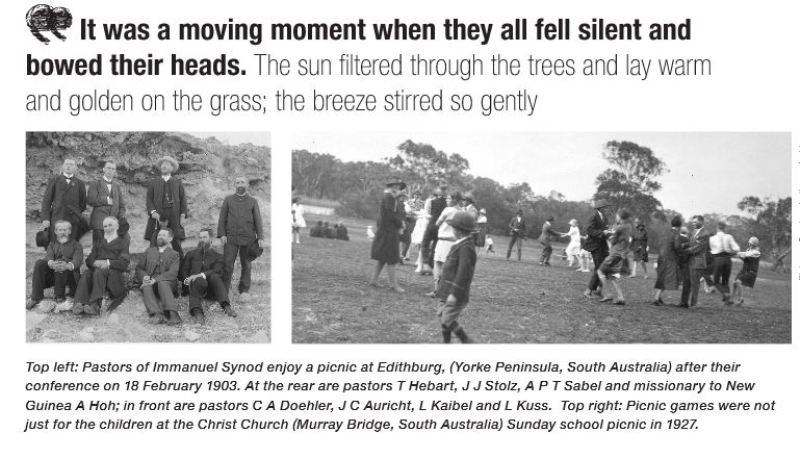
Now the nerves could finally settle and the excitement could begin! Presents were given to the students before the commencement of the annual school picnic. More residents of the district joined the occasion at the local ‘wooded lands’, swelling the numbers to 403. Games, shooting at the mark, music, dancing and choral performances were the order of the day.
And now we jump to 1984 and Murray Bridge Lutheran Primary School, South Australia. A request was made to author Colin Thiele to write a short story commemorating the Lutheran Sunday School picnic. His handwritten manuscript The Picnic, donated to the school, was recently deposited at Lutheran Archives. Colin’s story formed the basis of a picnic held in Tanunda in 1986 as part of South Australia’s 150th Jubilee celebrations. Many schools came together, donned period costumes, and relived the old-style picnic, so vividly portrayed by Colin:
As far as Eddie Nitschke was concerned the picnic was one of the highlights of the year. He always reminded his father about it in plenty of time. Sunday School was always held on Saturdays and so it was natural that the Sunday School Picnic was a Saturday function too.
Preparations began weeks beforehand. By the time the day arrived the baskets were bulging and the jars were full to the brim; big freshly-baked loaves of bread, a pound or two of butter squared into perfect shape with wooden butter-pats and finished with pretty patterns, sour cucumbers with an abominable smell and a heavenly taste, cheese, ham, mettwurst, black pudding, preserved fruits, cream, biscuits, cake and a dozen other delicacies.
They arrived in good time. Mild pandemonium was already erupting in several directions. Children were running about in a frenzy of freedom, dogs were barking and being told to shut up, horses were whinnying, cars were chugging proudly into place.
Albert Eckermann was in charge of the arrangements. He was an assistant to Pastor Eisenstein who was the real head of the Sunday School. But the pastor liked to delegate his picnic responsibilities because he wasn’t very comfortable out in the scrub. He had been brought up and educated in Germany and he hadn’t yet come to terms with the flies and the bull ants in a land that had gumtrees in place of cathedrals, dust instead of snow, and weird birds that laughed hysterically in the treetops in place of gentle storks and swans.
The egg and spoon race was held—a fierce thirty-yard dash with the handle of a dessert spoon clenched crossways in the teeth and an egg balanced perilously near the right cheek. The next event—the musical chairs—was immensely popular. So many children wanted to enter that there was a shortage of boxes and stools.
In every race there was a special prize for the winner—a big bag of lollies—and a heap of consolation prizes—smaller bags of lollies—for all the rest.
Two or three other events followed—a potato race and team competitions in tunnel ball and corner spry.
There was a hitch with the under-ten girls’ fifty-yard dash because Maria Schulz and Dulcie Schmidt were missing. Everything was held up for ten minutes while a search was organised. Eventually they were found down at the creek bottling tadpoles in one of Mutter Riedel’s pickle jars and had to be hauled up in their wet boots and stockings.
By the time lunch break arrived all contestants and spectators were ravenous. It was a moving moment when they all fell silent and bowed their heads. The sun filtered through the trees and lay warm and golden on the grass; the breeze stirred so gently. Pastor Eisenstein’s powerful voice gave thanks for good food and youthful vigour, for faith and friendship, and for that convivial Sunday School fellowship which was what picnics were all about.
A great tug-of-war ended the day.
It was almost time to pack up. The whole crowd was called together for a final assembly where all the helpers were thanked and the last remnants of food and cordial devoured. Eddie felt sad. There was something grey about the frayed end of the day that always made him feel like that—happiness ending, fun finished and a long wait before anything like it happened again.
Besides the annual school and Sunday school picnic, picnics were held to end pastor’s conferences, to celebrate church dedications, and as a time of fellowship for women’s guilds, youth fellowships and choirs. What a great way to celebrate and build community.
Longest Lutheran Lunch, anyone?
Rachel Kuchel is LCA Archivist.
