Home schooled

Many of us are familiar with the idea of our Lutheran forebears leaving Prussia to escape religious persecution. I’d hazard a guess, however, that many don’t realise that problems with the union church extended to the schooling of their children.
Sounds intriguing, yes?
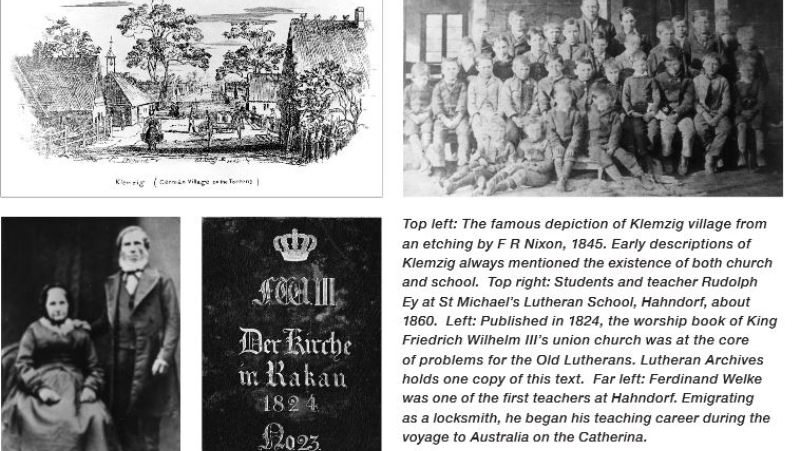
In the mid-18th century, Prussia introduced compulsory education which was neither secular nor free—schools were administered by the local pastor and paid for by parishioners. Problems for the ‘Old Lutherans’ began in 1817 when King Friedrich Wilhelm III introduced a worship book to be used in Prussian Lutheran churches. Its use (which our forefathers objected to) and the resulting Prussian Union of Churches, became compulsory in 1830. When the Old Lutherans rejected the union church and refused to worship in its congregations, they naturally stopped sending their children to parish schools.
We gathered them all together in one house, where we gave them instruction in all necessary subjects, which also went quite well, but that was not permitted by our former teachers here
Unfortunately there was no alternative school for them to attend. It seems that the authorities in the Züllichau district were particularly zealous in prosecutions of truant Old Lutherans. According to Gottlob Dolling in Rentschen 1833, ‘it started with forcing the children to go to school but then nothing came of that either so they came with truancy fines, which they didn’t pay either so their goods were confiscated’.
On 19 February 1832, the bailiff came to the Thiele family in Züllichau and confiscated their possessions, which included clothing (linen trousers, a waistcoat, a summer jacket, two aprons and five women’s caps), furniture (an old wardrobe, a table, mirror, footstool and cradle) and work items (a fishing net and wheelbarrow). A total of 25 items were confiscated that day, raising ten Thaler and eight silver Groschen. The Thiele family’s house was also consigned.
Gottfried Kruschel wrote that families attempted to educate their children themselves: ‘Now as far as school matters are concerned, dear brothers, we instructed our children ourselves, but that was not permitted, instead the local gendarmes and the bailiff drove them to school by force like sheep, but of course that only lasted as long as they were being driven, and when that did not work and we still kept our children home, truancy fines were imposed on the parents, six Pfenning a day … since with all these troubles we felt compelled by the need for our children to receive instruction, we gathered them all together in one house, where we gave them instruction in all necessary subjects, which also went quite well, but that was not permitted by our former teachers here, and so they were sent away by the gendarmes and the local authorities, and each one of us had to go back to teaching our own children ourselves, and the source of all our oppression is the afore-mentioned pastor of this place’.
Schooling ended for children when they were confirmed, which was generally around fourteen years of age. The problem here was that Old Lutheran parents were refusing to have their children confirmed in the union congregation by the union pastor, which meant there was no official end to their school days. A Pastor Wiedemann ‘maintains that school fees should be paid, that even if they have reached the age of fourteen and have not been confirmed by him, they have to pay school fees, even if they were 20 years old.’
After the Edict of Toleration was passed in 1845, Old Lutherans were permitted to conduct their own worship services, but it was still practically impossible for them to establish a school with an Old Lutheran teacher. While there may have been enough Old Lutherans in a particular location to form a congregation, it didn’t necessarily follow that there were enough school-aged children to form their own parish school. It is therefore possible that, even after 1845, families continued to migrate to Australia looking for the freedom to establish and attend a school based on the Lutheran Confessions.
A state school system was introduced into South Australia in the 1870s. It can well be argued that Lutherans had a system of schools already from 1839. Upon arrival in Australia schools were immediately established wherever they lived and wherever there was a congregation. In 1839 schools were established at Klemzig, Glen Osmond, Hahndorf and Piltawodli (for the local Kaurna children). Congregations were established at Klemzig and Hahndorf. The extra school at Glen Osmond, where Lutherans were also living, was established because the little children could not be expected to walk the distance to Klemzig each day for school, while this was considered feasible for Sunday worship. As each new village was established a school was opened as soon as practicable after the commencement of settlement.
Further information on this topic can be found in the Friends of Lutheran Archives Journal, 2013.
Lutheran Archives has a display commemorating 175 years of Lutheran schooling, running until April 2015. Pop in for a visit.
Rachel Kuchel is LCA Archivist.
